Percentage Calculator
Percentage Change Calculator
Percentage Increase Calculator
Percentage Decrease Calculator
Discount Calculator
Profit Margin Calculator
Markup Calculator
Percentage Difference Calculator
Reverse Percentage Calculator
VAT & Sales Tax Calculator
Tip Calculator
Salary Increase Calculator
Compound Growth Calculator
Percentage Error Calculator
Fraction to Percentage Calculator
Percentage to Fraction Calculator
Percentage of Total Calculator
Calculate percentages quickly and easily with our free online percentage calculator.
How to Calculate Percentages: A Simple Guide
Percentages are used everywhere — from working out discounts and price increases to calculating tips, taxes, profit margins and changes in value. Once you understand a few simple methods, percentage calculations become much easier.
In this guide, we'll explain how percentages work, show you the most common percentage formulas and give you simple examples you can use in everyday situations. You can also use PercentEasy's free calculators whenever you want the answer without doing the maths yourself.
What Is a Percentage?
A percentage is simply a way of expressing a number as a fraction of 100. The word “percent” literally means “per hundred”. So, for example, 25% means 25 out of every 100, which is the same as 25/100 or 0.25.
This makes percentages useful for comparing different values. Whether you're looking at a 20% discount, a 5% pay rise or a 15% profit margin, the percentage tells you the size of something relative to the whole.
Discount percentages are commonly used in shops, online sales and special offers. To calculate a discount, first work out the percentage of the original price, then subtract that amount from the original price.
Formula:
Discount Amount = (Discount Percentage ÷ 100) × Original Price
Example: An item costs £80 and has a 15% discount. What is the sale price?
Step 1: Convert 15% to a decimal: 15 ÷ 100 = 0.15
Step 2: Calculate the discount: £80 × 0.15 = £12
Step 3: Subtract the discount: £80 − £12 = £68
Answer: The sale price is £68.
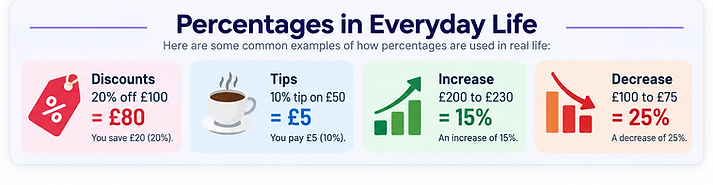
Quick Percentage Examples
Percentages come up in everyday situations. Here are a few common examples:
10% of £50
10 ÷ 100 × 50 = £5
20% tip on a £40 bill
20 ÷ 100 × 40 = £8
5% pay rise on a £30,000 salary
5 ÷ 100 × 30,000 = £1,500
New salary = £31,500
25% off a £60 item
25 ÷ 100 × 60 = £15
Sale price = £45
Common Percentage Mistakes
Using the wrong starting number:
For percentage increases and decreases, always divide the change by the original value, not the new value.
Confusing percentage change with percentage points:
If an interest rate rises from 4% to 5%, it has increased by 1 percentage point, but the percentage increase is 25%.
Adding a percentage and then subtracting the same percentage:
These do not cancel each other out. If £100 increases by 20%, it becomes £120. Reducing £120 by 20% gives £96, not £100.
Forgetting to divide by 100:
To use a percentage in a calculation, convert it to a decimal first. For example, 15% = 0.15 and 5% = 0.05.
Comparing percentages with different totals:
A percentage only makes sense in context. For example, 50% of 20 is 10, while 50% of 200 is 100.
Quick Percentage Shortcuts
10% — divide by 10
10% of £250 = £25.
5% — find 10%, then halve it
10% of £250 is £25, so 5% is £12.50.
1% — divide by 100
1% of £250 = £2.50.
25% — divide by 4
25% of £200 = £50.
50% — divide by 2
50% of £80 = £40.
75% — find three quarters
75% of £200 = £150.
These shortcuts are useful for quickly estimating discounts, tips, tax, price changes and other everyday percentage calculations without a calculator.
One of the most common percentage calculations is finding a percentage of a number. To do this, divide the percentage by 100 and multiply the result by the number.
Percentage of a number = (Percentage ÷ 100) × Number
Example: What is 20% of 150?
Step 1: Convert 20% to a decimal: 20 ÷ 100 = 0.20
Step 2: Multiply by the number: 0.20 × 150 = 30
Answer: 20% of 150 is 30.
Why this works: A percentage means “per hundred”, so 20% represents 20 parts out of every 100.
To find what percentage one number is of another, divide the first number by the second number and multiply by 100.
Formula:
Percentage = (Part ÷ Whole) × 100
Example: 30 is what percentage of 120?
Step 1: Divide the part by the whole: 30 ÷ 120 = 0.25
Step 2: Multiply by 100: 0.25 × 100 = 25%
Answer: 30 is 25% of 120.
This is a very common calculation when comparing sales figures, test scores, budgets, targets or any situation where you want to know how large one value is compared with another.
Percentage increase shows how much a number has grown compared with its original value. This is useful for things such as salary increases, price rises, sales growth and changes in costs.
Formula:
Percentage Increase = ((New Value − Original Value) ÷ Original Value) × 100
Example: A price increases from £80 to £100. What is the percentage increase?
Step 1: Find the increase: £100 − £80 = £20
Step 2: Divide the increase by the original price: £20 ÷ £80 = 0.25
Step 3: Multiply by 100: 0.25 × 100 = 25%
Answer: The price increased by 25%.
Percentage decrease measures how much a value has fallen compared with its original amount. It is commonly used for price reductions, discounts, falling costs, weight loss and decreases in sales or revenue.
Formula:
Percentage Decrease = ((Original Value − New Value) ÷ Original Value) × 100
Example: A price falls from £120 to £90. What is the percentage decrease?
Step 1: Find the decrease: £120 − £90 = £30
Step 2: Divide the decrease by the original price: £30 ÷ £120 = 0.25
Step 3: Multiply by 100: 0.25 × 100 = 25%
Answer: The price decreased by 25%.